In a world inundated with information, the power of well-crafted words cannot be overstated. The ability to wield the written word with precision is a skill worth mastering.
Here, we embark on a journey that explores the dynamic landscape of writing strategies. Unlocking the potential for fostering a deeper appreciation for the impact that words can have on the world
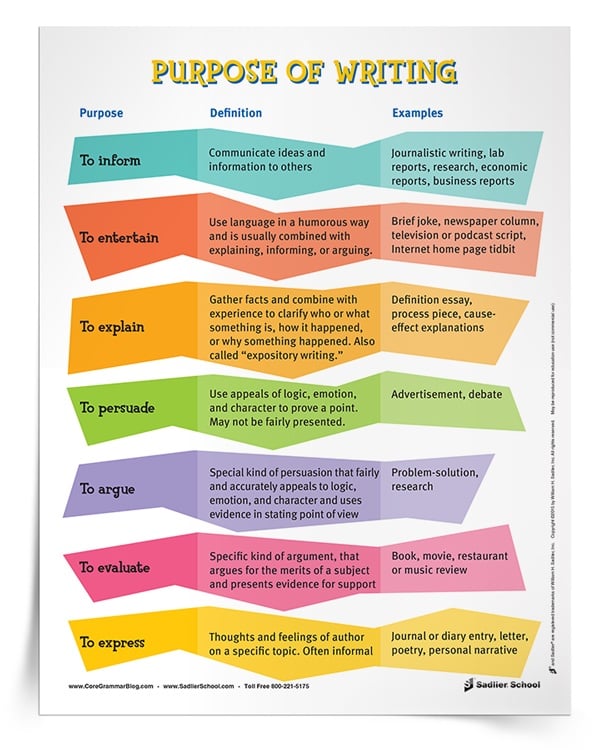
To Argue/ persuade-Try to present opposing positions accurately and fairly with only appeals to logical reasoning.
To evaluate-the merits of the subject and present evidence to support the claim.
. When evaluating, create a criterion you will use to make your judgment. It is impossible or even difficult to effectively evaluate someone immediately.
. Find supporting evidence to prove your point of view. you should not make general statements.
Example: a group assignment was given to us as a graded task. We were asked to observe a student while they engaged in writing. For us to efficiently evaluate the student, we had to know exactly what we were looking for; therefore, we formulated a checklist as our criterion. The checklist gave us some supporting details of what we expected the student to display or do.
It's commendable that you've considered the various perspectives on the purpose of writing, including personal expression, academic communication, and societal impact. This broad view enriches areas of discussion when considering why we want our learners to write.
While the blog touches on different purposes of writing, incorporating concrete examples or real-life scenarios could strengthen the points made. This would help readers connect more deeply with the content and understand how writing serves these purposes in practical terms.
Overall, the blog is a solid exploration of the purpose of writing, and with a few refinements, it has the potential to resonate even more with a diverse audience. Keep up the excellent work!
Our first session began by learning about two approaches "product and process approach." some of us were able to make sense of these words, however, we researched and shared. later on, we focused on: The product and process approach encourages writers to first generate ideas and drafts without focusing on too much perfection. With the product being the end results and the process being the steps taken to get to the end, they both are excellent ways to write. These two approaches have many similarities, some of which are : improves students' results in writing teaches involvement grammar and mechanics analysis recognize the importance of revision in writing steps/stages can be used for assessment when a final product is produced However, these processes are just as different as well because the product focuses more on the end results it does not spend time on coming up with ideas like process writing, rather it emphasizes on key components. It does no...
At the core of the educational process is the critical talent of academic writing. The capacity to express yourself clearly in writing is essential for everyone, whether they are researchers, teachers, or students (Smith, 2018). This blog will discuss academic writing, including its definition, functions, and fundamental elements, along with some advice on how to become an expert in this crucial field. What Is Academic Writing? Academic writing refers to a specific style of writing that is used in academic, scholarly, and professional settings. It is different from other forms of writing, such as creative writing or casual communication, because its primary purpose is to convey information, arguments, or research findings in a clear, structured, and objective manner (Johnson, 2016). Academic writing serves several important functions: · Communication: Scholars, students, and professionals share their knowledge, conce...
What makes an effective piece of writing? Good writers plan and revise, rearrange and delete text, re-reading and producing multiple drafts before they produce their finished document. This is what a process writing approach is about (Stanley, 2011). However, in my early years as a teacher, the product approach was mainly used in my classroom. Many of my students were pushed to create near perfect pieces of writing which was overwhelming for me but frustrating for my students. Students did not look forward to writing and I did not look forward to teaching it. Writing is a complex process involving brainstorming, drafting, revising, editing, and polishing in addition to actually putting words on paper. The process approach to writing is a core instructional strategy that can be used in elementary schools that helps young learners develop their writing skills and self-assurance. This method encourages creativity, critical thinking, and good communication skills by conc...
It's commendable that you've considered the various perspectives on the purpose of writing, including personal expression, academic communication, and societal impact. This broad view enriches areas of discussion when considering why we want our learners to write.
ReplyDeleteWhile the blog touches on different purposes of writing, incorporating concrete examples or real-life scenarios could strengthen the points made. This would help readers connect more deeply with the content and understand how writing serves these purposes in practical terms.
Overall, the blog is a solid exploration of the purpose of writing, and with a few refinements, it has the potential to resonate even more with a diverse audience. Keep up the excellent work!